Off the core, onto the stack — where real-time money movement belongs, and why.
There is a request the payments industry makes of core banking systems more and more often: Do more.
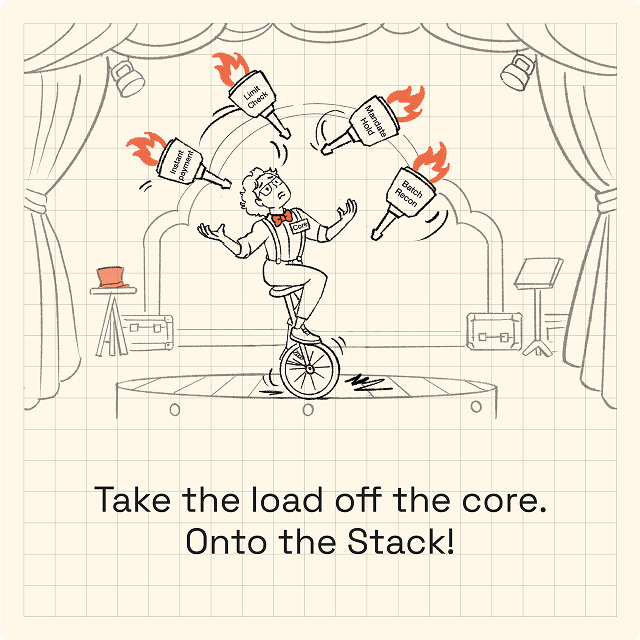
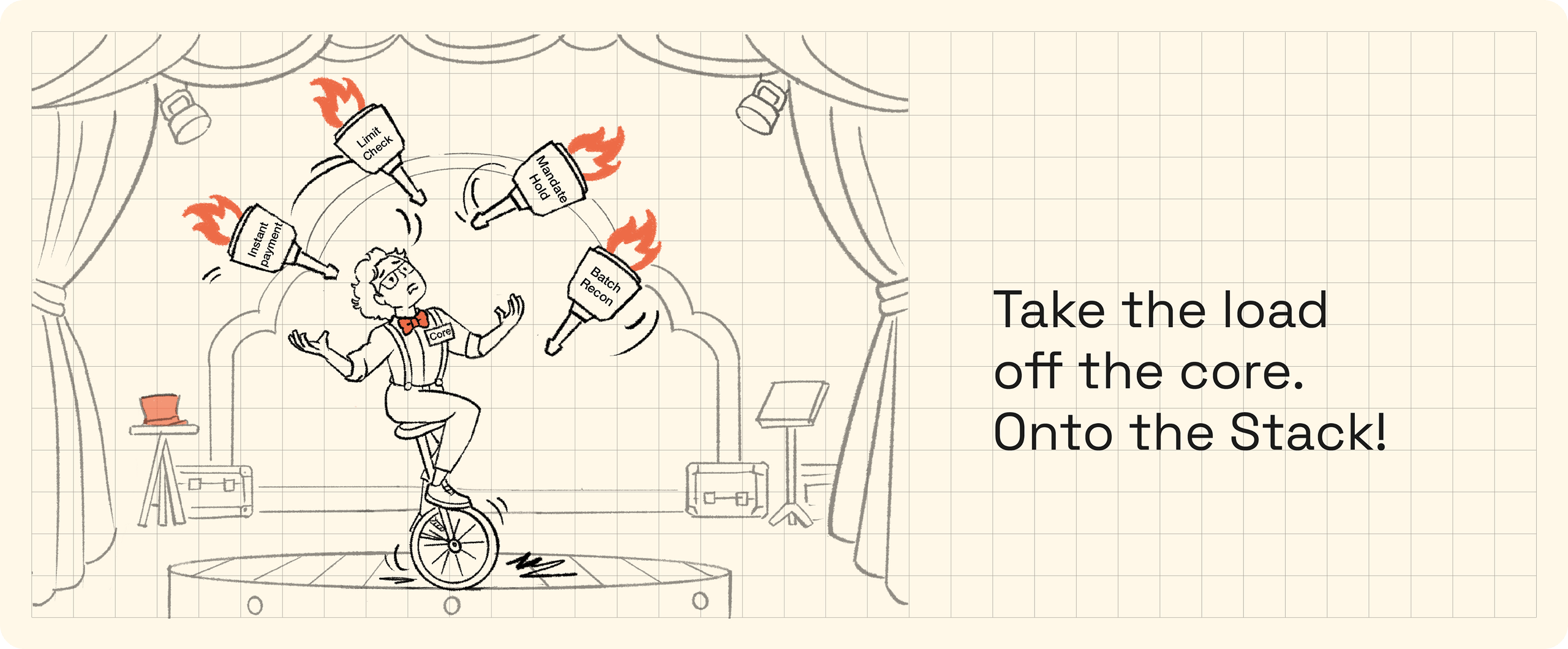
Process the instant payment. Check the limit. Hold the mandate. Reconcile the batch. Answer in under a second, a thousand times a second.
Usually, the core does it. For a while.
But what happens when a system designed to be the definitive record of balances is also asked to be the engine that moves them — thousands of times a second, under rules that change per rail and per market?
We have seen that situation firsthand.
And it offers a lesson about payments architecture:
A system of record and a payments engine are different jobs. Asking one system to do both eventually degrades both.
When one system for everything made sense
For most of banking history, payment volumes were modest and settlement was slow. A core system could record a transfer and process it in one motion, because there were not that many of them and nobody expected an answer in three hundred milliseconds.
That model was rational. For many things, it still is.
But then the shape of payments changed. Real-time rails arrived. Consumer payments became free and frequent. A single institution could go from thousands of transfers a day to millions — every one of them expecting an immediate answer.
The core did not get slower. The demand got faster.
When correctness and speed pull in opposite directions
The properties that make a core system a good system of record — careful locking, strict sequencing, conservative change control — are the same properties that make it a poor high-frequency engine.
You can tune it, add hardware, put caches in front of it. But every velocity check, every limit rule, every reconciliation job you bolt on is another workload competing for the same locks on the same accounts.
more payments → more rules on the hot path → more contention on the record.
The technology is working. Customers are transacting. And the system of record is slowly becoming the busiest, most fragile component in the estate — the one whose outage takes every channel down at once.
It stops being: can the core handle it? It becomes: should it have to?
Separate the record from the engine
The answer we converged on is not to replace the core. Replacing a core is a multi-year migration, and the record it holds is usually exactly what the institution should keep.
The answer is to put a payments layer beside it.
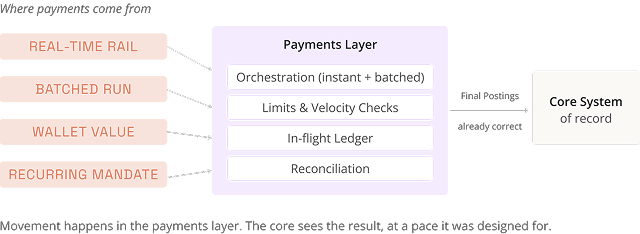
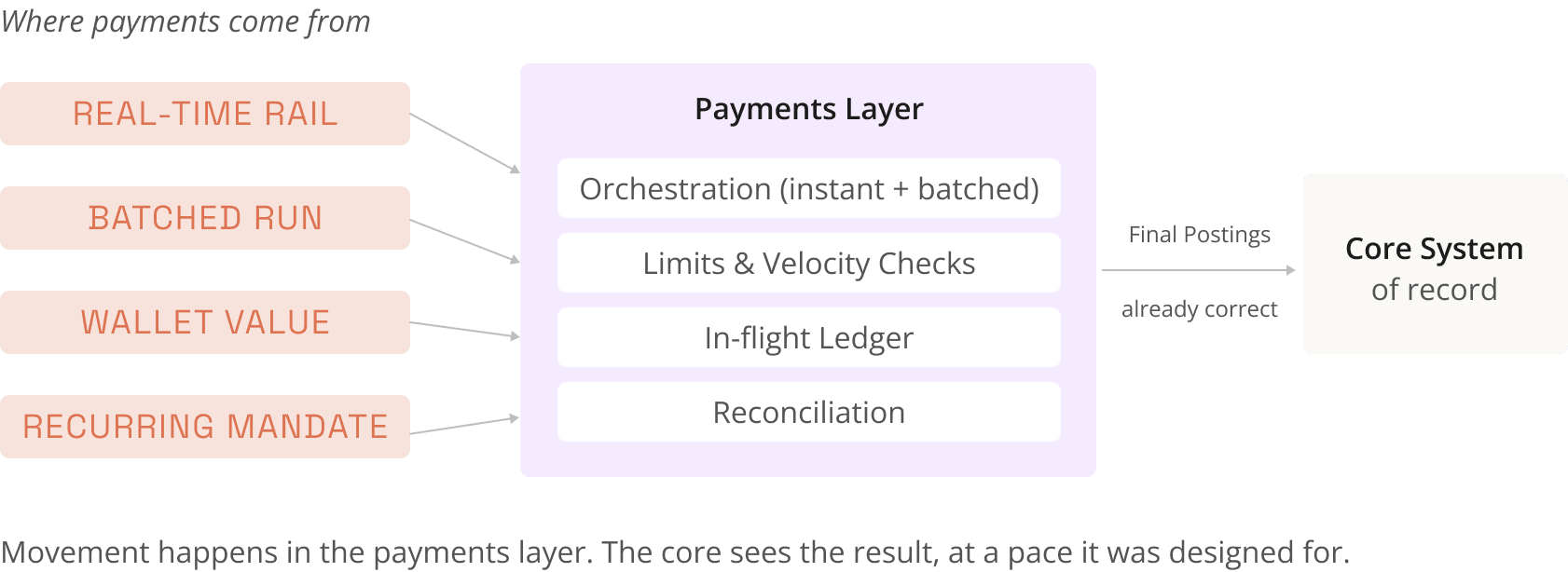
That layer owns the movement: orchestration across rails, real-time and batched; velocity and limit checks; the state of a transaction while it is in flight; reconciliation of what was promised against what was posted. It carries its own high-throughput ledger for the in-flight work.
The core keeps owning the truth. It receives already-correct postings, at a pace it was designed for.
The more interesting consequence
New rails become adapters, not core projects. A new limit rule is configuration in one place, not a change request against the system of record. Reconciliation runs on the engine’s schedule, not the core’s batch window.
And the core gets quieter — which is what a system of record should be.
Load taken off the core is not just cost saved. It is change control regained.
For a product team, that is the difference between a limit change that ships this week and one that waits for the next core release. For the CTO, it is the difference between a payments incident and a bank-wide one.
What we do not mean
This is not an argument that the core is legacy, or that it should be hollowed out. The core is valuable precisely because it is conservative. The mistake is asking a conservative system to also be a fast one.
Nor is it an argument for a second system of record. Two sources of truth is worse than one overloaded one. The payments layer holds in-flight state and hands over final state; it does not compete for ownership of balances.
Successful payments need a quiet core
The story is not that core systems failed. It is that payments changed shape faster than the systems recording them could reasonably be expected to.
If transaction volumes have multiplied tenfold, it is worth asking which of those transactions the core actually needs to see in real time — and which it only needs to see correctly.
A system of record was never meant to be a payments engine.
The record has to be right.
The engine has to be fast.
And the architecture has to stop pretending those are the same requirement.
 PREVIOUS
NEXT