

Why Some Real – Time Payment Systems Take Off — and Others Do Not
Real-time payment systems are now available in more than 100 jurisdictions. Yet their success has varied enormously. Some have become part of everyday life within a few years; others remain capable, reliable platforms processing relatively modest volumes.
The difference is rarely transaction speed. Almost every modern system can move money in seconds. The real question is whether enough banks, payment providers, merchants and customers have a reason to use it.
Consider the scale achieved by some of the leading systems. India processes approximately 24 billion transactions monthly on UPI, Brazil 8 billion monthly on PIX and Thailand 2.5 billion monthly on PromptPay.
These markets did not succeed through identical models. UPI combined bank-account interoperability with mobile applications, aliases and QR acceptance. Brazil’s central bank mandated participation in Pix for larger banks and built a low-cost merchant proposition. PromptPay made it easy to send money using mobile numbers, national identity numbers and business identifiers.
What they share is usefulness beyond just a faster bank transfer.
Person-to-person payments may introduce customers to a system, but merchant payments, bills, government disbursements, collections and business payments transform it into everyday infrastructure. The more situations in which the system can be used, the stronger its network effects become: customers adopt it because merchants accept it, while merchants accept it because customers use it.
The more mature systems are becoming general-purpose transaction platforms supporting commerce, recurring payments, credit, government services and cross-border transactions. India’s UPI is arguably the broadest example of this evolution, although Brazil’s Pix, Thailand’s PromptPay, Singapore’s PayNow and Australia’s NPP are developing along similar lines.
Participation matters, but so does what participants are allowed to connect.
Proportionate access for banks, payment institutions, fintechs and regulated wallet providers can broaden customer coverage, create more payment experiences and improve competition.
A common, interoperable QR standard can dramatically accelerate merchant acceptance. A merchant should ideally need only one QR code, while customers should be able to pay using any participating bank or wallet application. Without interoperability, merchants must display multiple QRs, customers remain locked into particular applications, and every provider must build its own acceptance network.
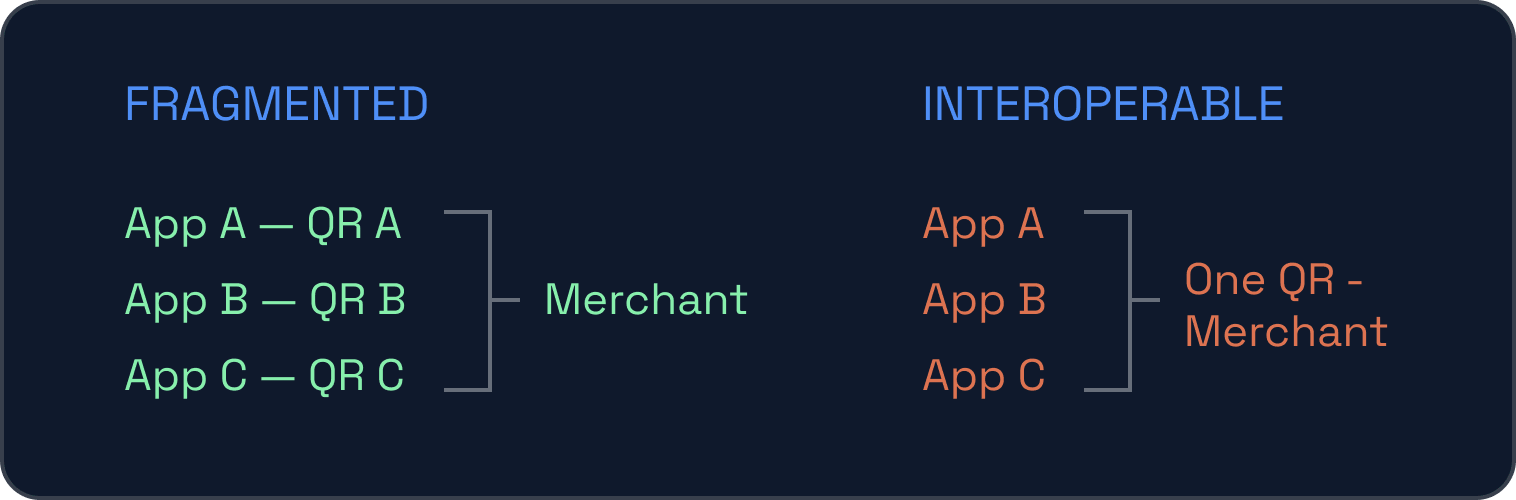
UPI, Thailand’s PromptPay and national QR standards such as Indonesia’s QRIS and the Philippines’ QR Ph have used interoperability to reduce this fragmentation. China followed a different path: Alipay and WeChat Pay initially built large but relatively closed acceptance ecosystems, with regulators subsequently pushing greater interoperability.
The types of accounts permitted on the system are equally important. A real-time payment scheme limited to conventional bank accounts may exclude e-money users, customers of non-bank providers and sections of the population without full-service banking relationships. Broader access can allow payments between bank accounts, prepaid wallets and regulated e-money accounts, while later extensions may support credit lines and other funding sources.
This does, however, increase the complexity of participation, KYC, settlement, safeguarding and consumer protection. Not every account type carries the same risk or regulatory treatment.
Successful systems tend to combine openness with common rules. Customers should not need to know whether the recipient uses a bank account or wallet, or whether a merchant’s QR was issued by a different provider. The more these distinctions disappear from the payment experience, the easier it becomes for the system to achieve scale.
What does it cost to use?
Pricing is another important part of the equation. If the new method costs customers or merchants more than familiar alternatives, speed alone may not persuade them to switch. India has MDR not applicable to most categories of merchant payments, and now has a threshold above which this may apply. Pix’s estimated merchant cost of 0.22%-0.33% was substantially below comparative credit and debit-card costs. In Europe, regulators have required instant-payment charges to be no higher than corresponding standard credit-transfer charges—recognising that availability without attractive pricing may not drive adoption.
Momentum in key markets
- Brazil’s Pix is closest to UPI in becoming a broad everyday payment platform, spanning P2P transfers, merchant QR payments, bills, government payments, cash withdrawal and recurring payments.
- Thailand’s PromptPay combines extensive P2P usage with merchant QR payments, government transfers and regional cross-border QR connectivity.
- Singapore’s PayNow covers consumers, businesses, government agencies and participating e-wallets. PayNow Corporate uses a business’s Unique Entity Number as an address, while PayNow QR is incorporated into SGQR.
- Australia’s NPP has developed from “pay anyone” transfers into richer business services: PayID addressing, detailed remittance data, PayTo mandates, government disbursements and inbound cross-border payments. The RBA has also identified potential future uses in payroll, merchant payments and after-hours financial-market payments.
- Europe, the UK and the US have strong transfer rails, but merchant acceptance and everyday payment use are generally less developed than in India or Brazil. Their next phase centres on request-to-pay, open-banking initiation, recurring payments and merchant checkout.
The Basics – Need, Trust and bullet-proof dispute processes
Existing payment habits also shape the outcome. In markets with limited card acceptance, real-time payments can fill an obvious gap. In heavily carded markets, the proposition must be more compelling than “faster”. FedNow in the United States, for example, entered a market already served by cards, ACH, cheques, wallets and an existing private-sector real-time network. Its development should therefore be judged as a gradual ecosystem build—not against the early growth curve of UPI or Pix.
Trust can accelerate or constrain that growth. Customers need confidence that they are paying the correct recipient and that mistakes and fraud will be handled fairly. Verification of payee, clear liability rules and effective redress are therefore not peripheral features; they are adoption features.
Customers and merchants need clear processes for failed, delayed, duplicated, misdirected, unauthorised and fraud-induced payments, with defined responsibilities, response times and return mechanisms. Reliable transaction status, end-to-end traceability and consistent liability rules are essential to building trust, particularly as instant payments expand into merchant, recurring and cross-border use cases.
Launching a real-time rail is a major achievement. A rail becomes a successful payment ecosystem only when it combines reach, interoperable acceptance, inclusive account access, useful experiences, viable economics and trust.
Technology makes the payment instant. Market design makes it popular.
 PREVIOUS
NEXT